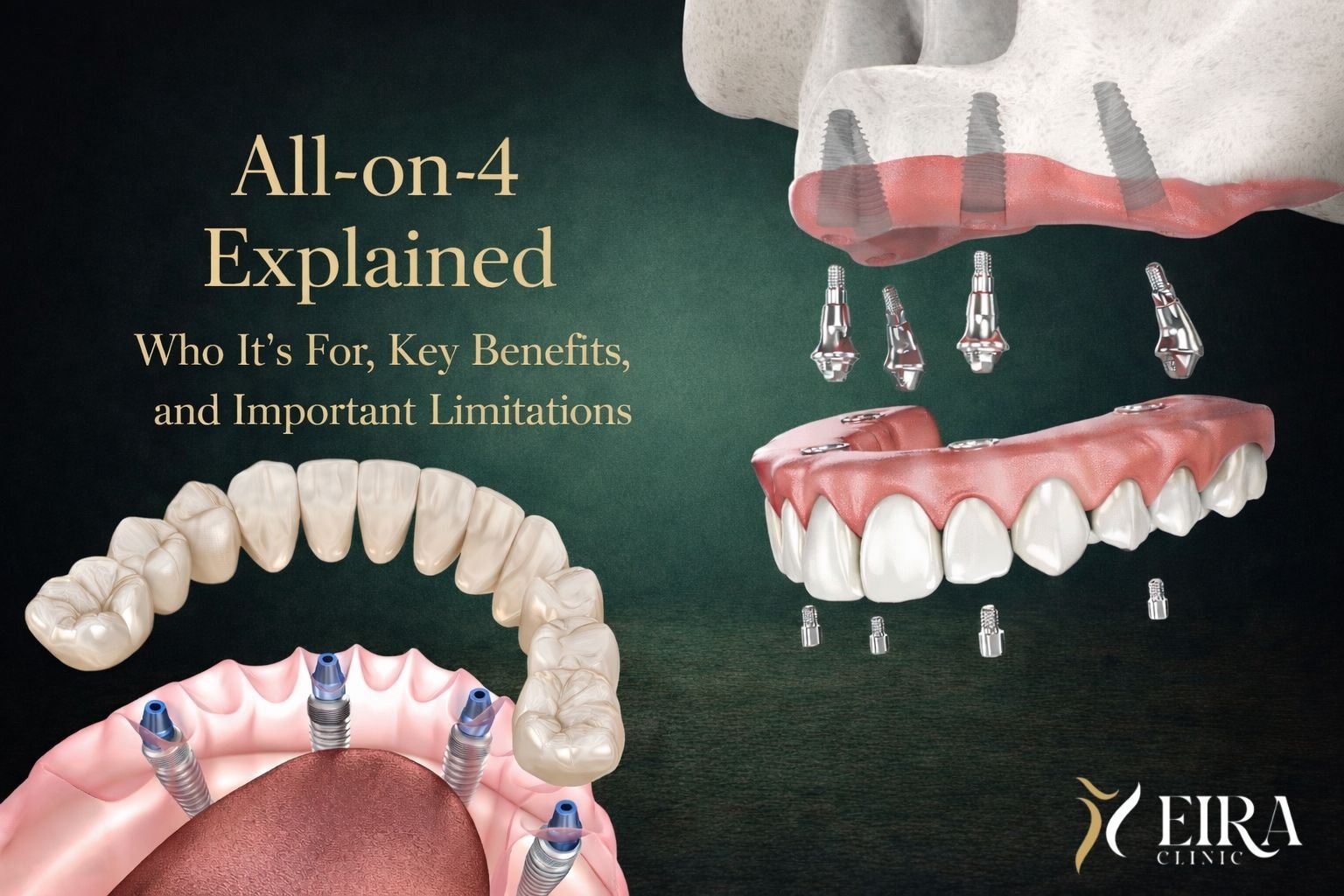
All-on-4 Explained
Who It’s For, Key Benefits, and Important Limitations
For patients who have lost most or all of their teeth, or whose remaining teeth can no longer be saved, All-on-4 offers a fixed, full-arch solution that restores function, confidence, and quality of life.
All-on-4 is not just a dental procedure —
it is a full-mouth rehabilitation concept that combines surgery, prosthetics, and biomechanics.
This article explains what All-on-4 really is, who it’s for, and when it may not be the best option.
⸻
What Is All-on-4?
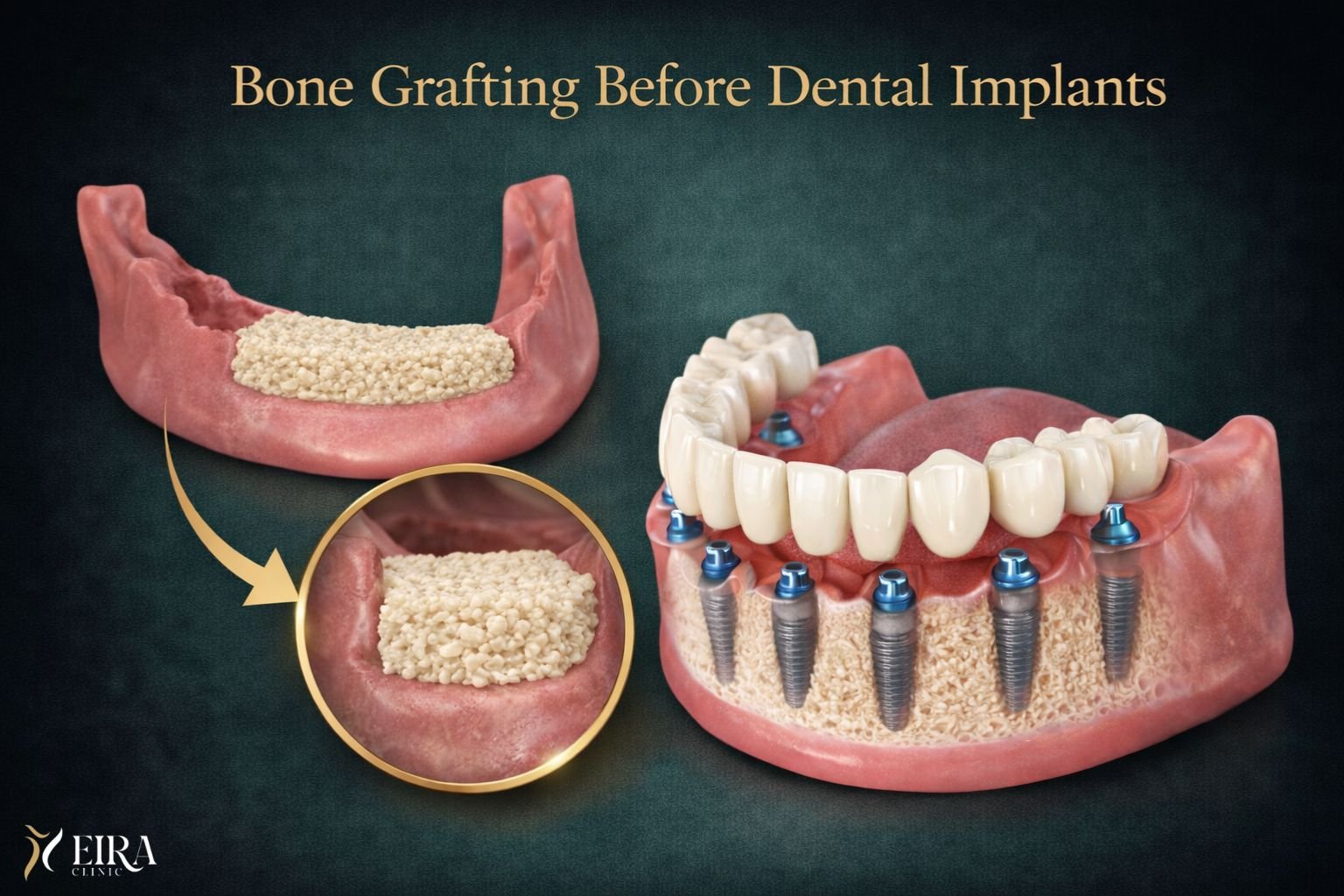
All-on-4 is a full-arch dental implant technique that uses four strategically placed implants to support a complete set of fixed teeth.
The implants are placed as follows:
• Two implants in the front of the jaw
• Two implants angled in the back to maximize bone contact
This angulation often allows treatment without extensive bone grafting, even in patients with some bone loss.
⸻
Why the All-on-4 Concept Works
The success of All-on-4 is based on biomechanical principles, not marketing.
Key Functional Advantages
1️⃣ Strategic Implant Angulation
Angled implants increase contact with existing bone and improve stability.
2️⃣ Load Distribution
Chewing forces are spread across the arch rather than concentrated in one area.
3️⃣ Fixed Prosthetic Teeth
Patients receive non-removable teeth that feel stable and natural.
4️⃣ Reduced Surgical Complexity
In many cases, All-on-4 avoids bone grafting procedures.
⸻
Who Is a Good Candidate for All-on-4?
All-on-4 may be suitable for patients who:
• Are missing most or all teeth
• Have failing teeth that need extraction
• Have mild to moderate bone loss
• Are unhappy with removable dentures
• Want a fixed solution with fewer implants
A detailed medical and radiographic evaluation is essential before confirming suitability.
⸻
Immediate Teeth: What Patients Need to Understand
In many cases, All-on-4 allows for immediate loading, meaning:
• A temporary fixed bridge can be placed shortly after surgery
• Patients leave with teeth on the same day or within 24 hours
⚠️ Important:
Immediate teeth are temporary, designed to protect implants during healing.
Final teeth are placed only after full integration.
⸻
Benefits of All-on-4
Patients often choose All-on-4 because it offers:
• Fixed, non-removable teeth
• Improved chewing and speech
• Faster treatment timeline
• Often reduced need for bone grafting
• Restored confidence and facial support
For the right patient, All-on-4 can be life-changing.
⸻
Important Limitations of All-on-4
All-on-4 is highly effective — but it is not ideal for every case.
Potential limitations include:
• Less load distribution compared to All-on-6
• Higher stress per implant
• Requires precise planning and execution
• Not suitable for very strong bite forces in some patients
This is why proper diagnosis is critical.
⸻
All-on-4 Is Not a “One-Size-Fits-All” Solution
One of the biggest mistakes in implant dentistry is treating All-on-4 as a package.
At an advanced level, treatment planning must consider:
• Bone density, not just volume
• Bite force and chewing pattern
• Jaw anatomy
• Long-term prosthetic design
When these factors are ignored, complications increase.
⸻
Long-Term Outlook and Maintenance
With proper planning and care, All-on-4 can provide:
• Long-term stability
• Excellent function
• High patient satisfaction
Maintenance includes:
• Daily oral hygiene
• Professional cleaning
• Regular follow-up evaluations
⸻
Frequently Asked Questions (FAQ)
Is All-on-4 permanent?
Yes. The implants are permanent. The prosthetic teeth may be updated over time.
Can All-on-4 fail?
Failure is rare when cases are properly selected and planned.
Is All-on-4 better than dentures?
Yes. Fixed teeth provide superior comfort, function, and confidence.
⸻
Final Thoughts
All-on-4 is a powerful solution —
but its success depends entirely on diagnosis, planning, and execution.
When done correctly, it restores far more than teeth.
It restores function, dignity, and quality of life.