A Simple, Honest Guide for Patients Considering Dental Implants
For many patients, the upper back jaw presents a unique challenge for dental implants —
not because of weak bone, but because of the maxillary sinus.
Hearing the term “sinus lift” can sound complex or alarming.
In reality, sinus lift surgery is a well-established, predictable procedure that safely makes implant placement possible.
This article explains what a sinus lift is, why it’s needed, and what patients should expect — without unnecessary fear.
⸻
Why the Sinus Can Limit Implant Placement
The maxillary sinus is an air-filled cavity located above the upper back teeth.
After tooth loss:
- The jawbone begins to shrink
- The sinus gradually expands downward
- Available bone height decreases
This can leave insufficient bone to safely place dental implants in the upper jaw.
⸻
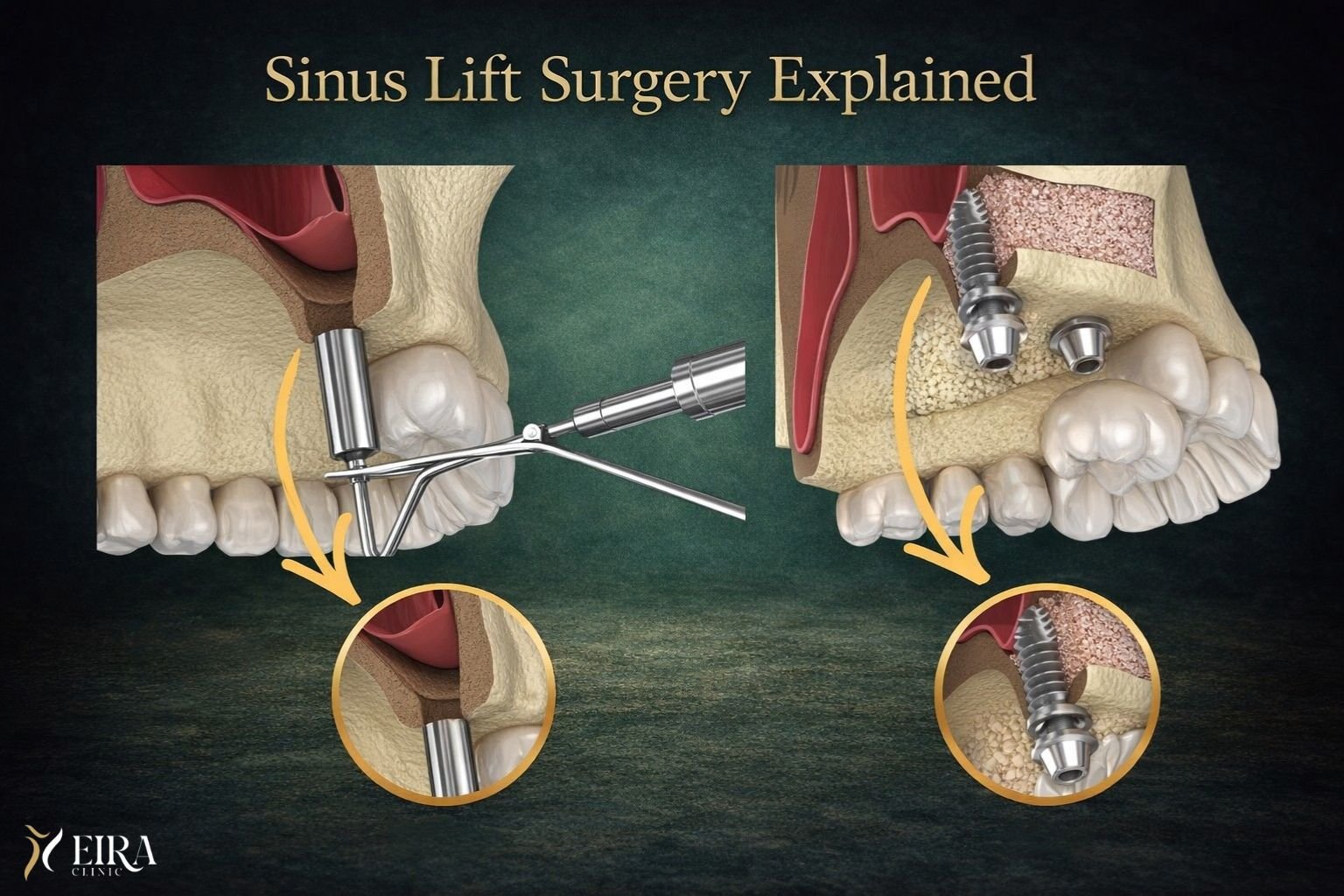
What Is a Sinus Lift?
A sinus lift is a surgical procedure that:
- Gently lifts the sinus membrane upward
- Creates space beneath it
- Adds bone material to increase bone height
This newly created bone allows dental implants to be placed safely and predictably.
⸻
Types of Sinus Lift Procedures
The type of sinus lift depends on how much bone is available.
1️⃣ Closed (Internal) Sinus Lift
- Less invasive
- Performed through the implant site
- Suitable when a small bone increase is needed
Often done at the same time as implant placement.
⸻
2️⃣ Open (Lateral) Sinus Lift
- Used when more bone is required
- Accessed from the side of the jaw
- Allows greater bone augmentation
Implants may be placed later or simultaneously, depending on stability.
⸻
Is Sinus Lift Surgery Safe?
Yes.
When performed by experienced professionals, sinus lift surgery has high success rates.
Safety depends on:
- Accurate diagnosis
- Gentle surgical technique
- Proper case selection
- Respecting healing timelines
Sinus lift procedures are routine in advanced implant centers worldwide.
⸻
Does a Sinus Lift Affect Breathing?
No.
A properly performed sinus lift does not affect breathing, sinus function, or airflow.
The sinus membrane is lifted gently and remains intact.
⸻
Is Sinus Lift Surgery Painful?
Most patients report:
- Minimal discomfort
- Mild swelling
- Temporary pressure sensation
Pain is usually well controlled and comparable to other minor oral surgeries.
⸻
Healing and Implant Placement Timeline
Healing depends on:
- Type of sinus lift
- Amount of bone added
- Individual healing capacity
Implants may be placed:
- At the same time as the sinus lift
- Or after a healing period
Rushing implant placement increases risk — healing is part of success.
⸻
Why Sinus Lifts Improve Implant Success
Without adequate bone height:
- Implants lack stability
- Failure risk increases
A sinus lift:
- Creates proper bone support
- Allows ideal implant positioning
- Protects long-term outcomes
It transforms “impossible” cases into successful implant treatments.
⸻
Common Myths About Sinus Lift Surgery
“Sinus lifts are dangerous.”
❌ False. They are predictable when properly planned.
“It affects sinus health.”
❌ False. Sinus function remains normal.
“It’s a rare procedure.”
❌ False. It’s routinely performed in implant dentistry.
⸻
Frequently Asked Questions (FAQ)
Will I feel pressure during the procedure?
Some pressure is normal, but pain is not.
Can implants be placed without a sinus lift?
Only if sufficient bone height exists — otherwise, a sinus lift is safer.
How long does healing take?
Healing varies, but proper timing ensures long-term success.
⸻
Final Thoughts
A sinus lift is not a complication —
it is a solution that expands treatment possibilities.
With correct diagnosis and technique, it allows dental implants to be placed safely and confidently in the upper jaw.